Species page
Great White Shark
Common name: White shark
Fast, powerful apex predator built for bursts of speed.
Carcharodon carcharias
Vulnerable
Species page
Common name: White shark
Fast, powerful apex predator built for bursts of speed.
White sharks are wide-ranging hunters of productive temperate seas, moving between coastal feeding areas and offshore routes. Their shape is simple and unmistakable: a robust gray back, bright white belly, and broad serrated teeth. Despite their reputation, most people will never encounter one in the wild. A heavy torpedo-shaped shark with a pointed snout, tall triangular first dorsal fin, broad crescent tail, and large triangular serrated teeth. The upper body is usually gray to brownish and contrasts sharply with a white underside. Widely distributed in temperate and subtropical seas of both hemispheres. It occurs near productive coasts, offshore islands, shelf edges, and open-ocean routes linking seasonal feeding areas.
White sharks use habitats from the surf zone and rocky headlands to pelagic waters over deep basins. Juveniles are more often associated with coastal nurseries, while larger animals move between coastal feeding sites and offshore waters.
One of the most recognized sharks in the world.
Why it matters: Like other lamnid sharks, it can keep parts of its body warmer than the surrounding sea, which helps it hunt in cold productive water.
A heavy torpedo-shaped shark with a pointed snout, tall triangular first dorsal fin, broad crescent tail, and large triangular serrated teeth. The upper body is usually gray to brownish and contrasts sharply with a white underside.
Widely distributed in temperate and subtropical seas of both hemispheres. It occurs near productive coasts, offshore islands, shelf edges, and open-ocean routes linking seasonal feeding areas.
White sharks use habitats from the surf zone and rocky headlands to pelagic waters over deep basins. Juveniles are more often associated with coastal nurseries, while larger animals move between coastal feeding sites and offshore waters.
Countershaded stealth body
Compare it against Great Hammerhead.
This species is involved in some of the world's most serious shark bite incidents, but encounters remain rare at ocean scale. Fishing pressure, bycatch, and trade in fins and jaws have also contributed to population decline.
These links are meant to help readers continue through related species, not force extra clicks.
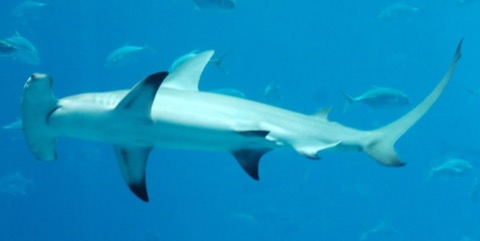
Long-cephalofoil hunter that patrols warm coastal waters.