Species page
Barbeled houndshark
Common name: Leptocharias Smithii
Shark species in Leptochariidae.
Leptocharias smithii
Species page
Common name: Leptocharias Smithii
Shark species in Leptochariidae.
The barbel-bearing shark in this family is a tropical West African coastal specialist. For PocketShark, treat it as a small, unusual houndshark-like species with a notably localized range. The family is distinctive for the paired barbels near the nostrils, a slender body, and a head shape unlike typical requiem or catsharks. This family is represented by a West African tropical coastal shark with a relatively restricted eastern Atlantic range.
It occupies shallow continental shelf waters, estuaries, and muddy coastal habitats.
Added from the World Register of Marine Species (WoRMS).
Why it matters: It is one of the few carcharhiniform sharks with conspicuous barbels.
The family is distinctive for the paired barbels near the nostrils, a slender body, and a head shape unlike typical requiem or catsharks.
This family is represented by a West African tropical coastal shark with a relatively restricted eastern Atlantic range.
It occupies shallow continental shelf waters, estuaries, and muddy coastal habitats.
Family: Leptochariidae
Compare it against Apristurus Nasutus, white ghost catshark, and African ribbontail catshark.
This is not a shark that commonly interacts with swimmers or divers. Its importance is mostly conservation and fisheries related.
Species-level taxonomy was verified from Sharkipedia's current species list and taxonomy workbook. In this pass, the narrative fields are cautious family-level placeholders synthesized from broad shark references, chiefly the FAO Sharks of the World catalogue, because a stronger multi-source species-level synthesis was not assembled here without risking invented detail. Replace this with a direct species-level synthesis before publication in the app.
These links are meant to help readers continue through related species, not force extra clicks.
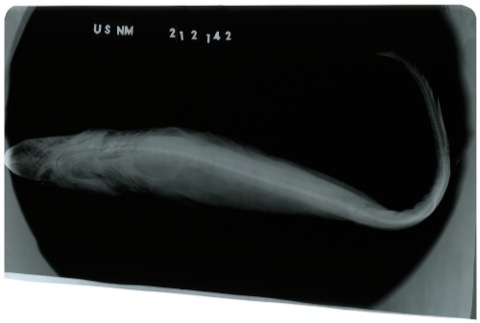
Shark species in Pentanchidae.
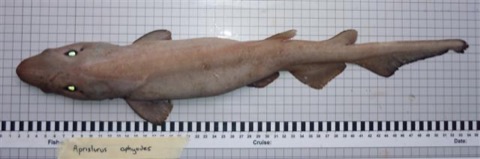
Shark species in Pentanchidae.
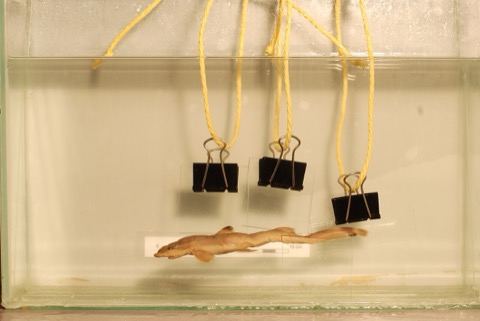
Shark species in Proscylliidae.
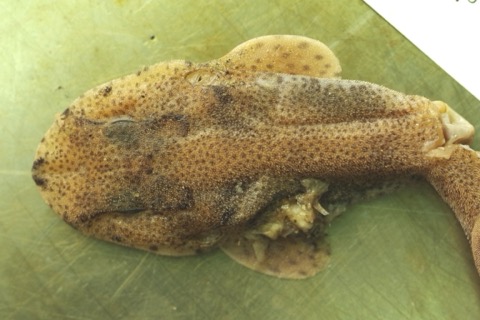
Shark species in Pentanchidae.