Species page
Greenland shark
Shark species in Somniosidae.
Somniosus microcephalus
Species page
Shark species in Somniosidae.
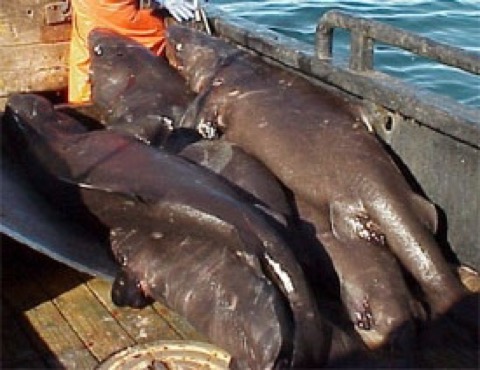
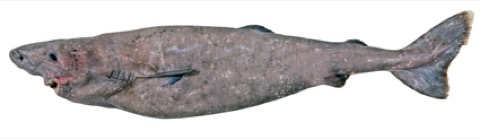
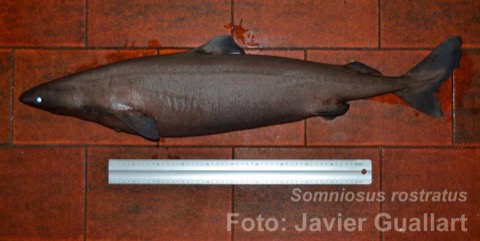
The Greenland shark is a slow, cold-water giant of Arctic and North Atlantic seas. Much of its life happens out of sight in dark water, yet it may be among the most long-lived vertebrates on Earth. For a field guide, its heavy body, small dorsal fins, and somber color are the key first impressions. A large heavy shark with a blunt snout, tiny eyes, two small dorsal fins set far back, and a mostly uniform dark gray to brown body. It lacks an anal fin, which helps separate it from many shallow-water sharks. Occurs in Arctic and North Atlantic waters, including high Arctic shelves, fjords, and deep offshore basins, and extends into colder temperate parts of the North Atlantic.
Usually associated with cold deep water, but it can occur much shallower in polar seas and fjord systems where low temperatures reach the surface.
Added from the World Register of Marine Species (WoRMS).
Why it matters: It is one of the strongest candidates for the longest-lived vertebrate known to science.
A large heavy shark with a blunt snout, tiny eyes, two small dorsal fins set far back, and a mostly uniform dark gray to brown body. It lacks an anal fin, which helps separate it from many shallow-water sharks.
Occurs in Arctic and North Atlantic waters, including high Arctic shelves, fjords, and deep offshore basins, and extends into colder temperate parts of the North Atlantic.
Usually associated with cold deep water, but it can occur much shallower in polar seas and fjord systems where low temperatures reach the surface.
Family: Somniosidae
Compare it against Pacific sleeper shark, Somniosus Antarcticus, and Somniosus Cheni.
Human encounters are uncommon because most animals live in cold remote waters. The main concerns are bycatch, historical harvest in some regions, and an exceptionally slow life history.
IUCN, Sharkipedia, Smithsonian summaries, and broad shark catalogues agree on the cold North Atlantic–Arctic distribution and very slow life history. The remarkable lifespan estimates are influential but still framed cautiously here because exact age interpretation remains a specialist topic.
These links are meant to help readers continue through related species, not force extra clicks.
Shark species in Somniosidae.
Shark species in Somniosidae.
Shark species in Somniosidae.
Shark species in Somniosidae.