Species page
Common Thresher
Uses a whip-like tail to stun fish schools.
Alopias vulpinus
Vulnerable
Species page
Uses a whip-like tail to stun fish schools.
This species belongs to the thresher shark family, famous for a whip-like tail longer than most sharks ever grow. Even when details vary between species, that tail is the quickest clue in the field. The defining feature is the extremely elongated upper lobe of the tail, often nearly as long as the rest of the body. The body is streamlined with long pectoral fins and a pointed snout. Threshers occur in tropical, subtropical, and temperate seas around the world. Most records come from oceanic and shelf-edge waters, though some species also approach coasts and islands.
Most species spend much of their time in the upper water column over deep water, with regular use of offshore banks, seamounts, and outer continental shelves.
Known for one of the most dramatic hunting tools in sharks.
Why it matters: A thresher's tail is not just for propulsion; it can also be used as a prey-handling tool.
The defining feature is the extremely elongated upper lobe of the tail, often nearly as long as the rest of the body. The body is streamlined with long pectoral fins and a pointed snout.
Threshers occur in tropical, subtropical, and temperate seas around the world. Most records come from oceanic and shelf-edge waters, though some species also approach coasts and islands.
Most species spend much of their time in the upper water column over deep water, with regular use of offshore banks, seamounts, and outer continental shelves.
Tail nearly as long as the body
Compare it against Bigeye thresher and Pelagic thresher.
Direct conflict with people is uncommon. The larger conservation issue is fishing pressure, especially from pelagic longlines and other high-seas gear.
These links are meant to help readers continue through related species, not force extra clicks.
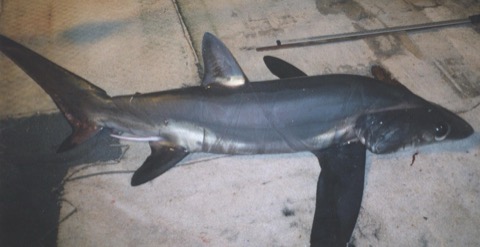
This species belongs to the thresher shark family, famous for a whip-like tail longer than most sharks ever grow. Even when details vary between species, that tail is the quickest clue in the field.
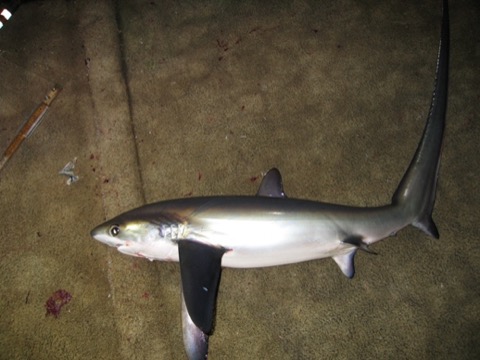
Common name: fox shark
This species belongs to the thresher shark family, famous for a whip-like tail longer than most sharks ever grow. Even when details vary between species, that tail is the quickest clue in the field.