Species page
Shortfin Mako
Common name: Shortfin mako shark
One of the ocean’s fastest sharks.
Isurus oxyrinchus
Endangered
Species page
Common name: Shortfin mako shark
One of the ocean’s fastest sharks.
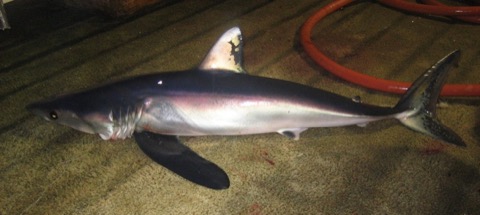
The shortfin mako is built for speed: slim, powerful, and tuned for chasing fast pelagic prey. It spends much of its life in open water, sometimes crossing whole ocean regions. Modern assessments point much more strongly to fishing pressure than to conflict with people. A streamlined spindle-shaped shark with a pointed snout, very long gill slits, narrow-bladed teeth that remain visible when the mouth is closed, and a strongly lunate tail. The body is metallic blue-gray above and white below. Circumglobal in tropical to temperate seas, especially in oceanic waters but also over continental shelves and around islands.
Often occupies the upper water column offshore, though it also visits shelf-edge and coastal areas. It ranges through warm and temperate surface waters and can dive deeply during foraging.
An important indicator of pelagic trophic health.
Why it matters: Its body design is so efficient that makos are widely cited as among the fastest sharks in the open ocean.
A streamlined spindle-shaped shark with a pointed snout, very long gill slits, narrow-bladed teeth that remain visible when the mouth is closed, and a strongly lunate tail. The body is metallic blue-gray above and white below.
Circumglobal in tropical to temperate seas, especially in oceanic waters but also over continental shelves and around islands.
Often occupies the upper water column offshore, though it also visits shelf-edge and coastal areas. It ranges through warm and temperate surface waters and can dive deeply during foraging.
Rapid endothermic swimming and burst acceleration
Compare it against longfin mako and Great White Shark.
Occasional bites or boat strikes are documented, especially when hooked or handled, but the major concern is heavy fishing pressure from targeted and incidental capture.
IUCN, NOAA, Sharkipedia, and general shark references converge on a wide oceanic distribution, high mobility, and oophagous live-bearing reproduction. Maximum size differs among references, so the upper value here stays within the better-supported 4 to 4.45 m range.
These links are meant to help readers continue through related species, not force extra clicks.
Common name: Longfin mako shark
Shark species in Lamnidae.
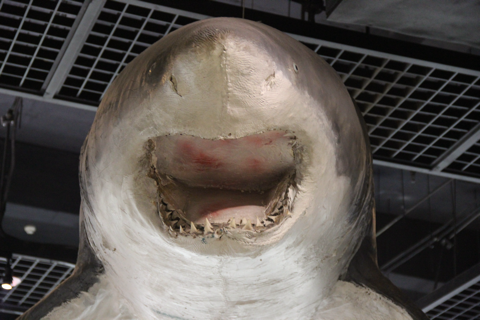
Common name: White shark
Fast, powerful apex predator built for bursts of speed.